Build vs. buy data pipelines: Costs to consider
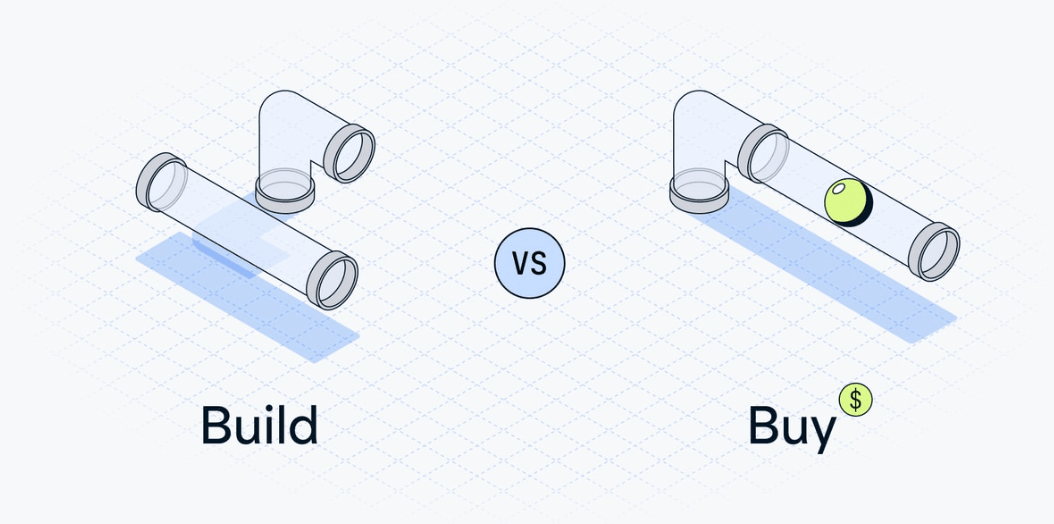


For most growing businesses, the biggest cost of building a data pipeline isn't the initial development — it's everything that comes after. Maintaining connectors, fixing broken pipelines, adapting to schema changes, and supporting new data requests can consume valuable engineering time that could be spent on higher-impact work.
In fact, 97% of businesses report delays to analytics or AI initiatives because of data pipeline issues. This article explores the hidden costs of building and maintaining custom data pipelines—and why more organizations are choosing managed solutions instead. Because the real decision isn't simply build versus buy — it's build, maintain, debug, scale, and continuously improve versus buy.
[CTA_MODULE]
The setup costs of buying vs. building data pipelines
The first cost to consider is getting your data from the tools you use every day into a central data warehouse. If you're connecting just one application, building your own pipeline may be manageable. But as your business scales, so does the number of systems you rely on.
Imagine you want to combine data from Salesforce, Google Ads, HubSpot, Postgres, and Stripe in BigQuery for reporting and AI. A typical task breakdown consists of:
- Assembling your lean data team
- Analyzing the source/destination requirements and system architecture
- If you build your solution, you will have to write software to pull data from different sources. By contrast, if you buy a solution, you will have to choose a third-party data integration tool
- Testing the data integration
Overall, whether you build or buy, you'll need to plan the architecture, connect each source, and validate the data. For those looking to scale their business, if you choose to build, developing and maintaining those integrations (step 3 above) quickly becomes the most time-consuming and expensive part of the project.
Let's analyze the cost in the following build vs. buy scenarios.
Build: The setup cost
Building data pipelines is only the start. Once they're live, someone has to keep them running. Every API update, schema change, authentication issue, or outage becomes your team's responsibility — no matter your headcount.
For smaller businesses, those maintenance demands add up. According to Fivetran’s most recent benchmark report, organizations spend an average of 7.5% of their data budget just maintaining pipelines.
These costs also extend far beyond infrastructure. Every hour spent maintaining fragile pipelines or responding to failures is engineering time that can't be spent delivering new products, enabling AI initiatives, or solving higher-value business problems. And as organizations add more applications and AI workloads, the cost of owning bespoke integrations continues to grow, making data pipeline maintenance a strategic burden rather than simply an operational expense.
Buy: The setup cost
With a managed data integration solution, you can start moving data in hours instead of spending weeks building and maintaining custom pipelines. Rather than writing code for every connection, your team simply configures the data sources they need and gets back to work.
For growing businesses with lean engineering teams, that means less time fixing broken pipelines or responding to API changes and more time building dashboards, supporting the business, and putting AI to work. As your company adds new applications, a managed solution scales with you — without increasing the maintenance burden on your team.
The results can be significant. Janie and Jack, a Go Global retail brand, used Fivetran to eliminate 40% of data engineering work. Fivetran enabled a single data scientist at Loom to operationalize warehouse data across Zendesk, Salesforce, and Intercom. At Axon, Fivetran allowed a team of 3 to operate like a team of 6, giving engineers more time to deliver business value instead of managing infrastructure. And at Interloop, Fivetran helped them reduce pipeline maintenance from 20-30% of analyst time to less than 5%, allowing teams to focus on generating insights and delivering value more quickly.
Beyond the ongoing savings in engineering time and budget, buying a managed solution also reduces upfront investment and project risk. You avoid the uncertainty of custom development, where timelines, costs, and maintenance requirements often grow as new edge cases emerge. Most vendors also offer free trials or proofs-of-concept, making it easier to estimate costs and validate the solution before committing to a long-term investment.
The maintenance costs of buying vs. building data pipelines
Data pipelines must be rebuilt whenever upstream data schemas change at the source or a business needs new downstream data models. Maintenance imposes an ongoing burden that forces your data engineers to frequently revisit old code written by other people and distracts them from higher-value work. This problem scales as data sources are added.
Build: The maintenance cost
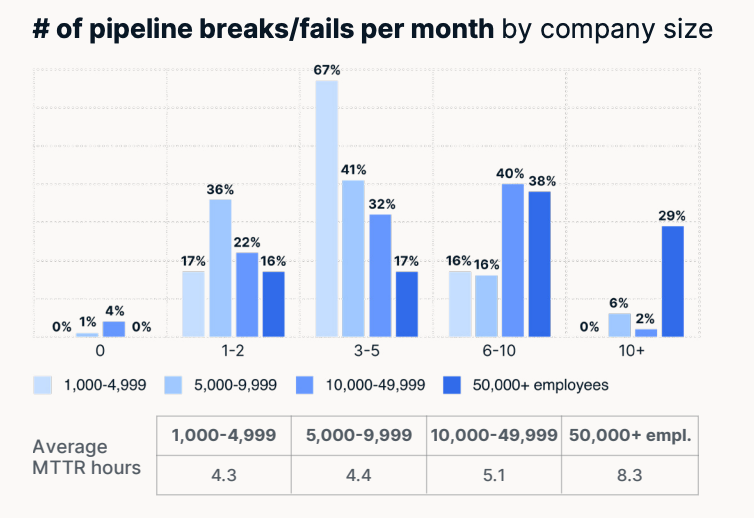
When you build your own pipelines, you also own the ongoing maintenance — from bug fixes and upgrades to security and monitoring. Research shows data teams spend 53% of engineering time maintaining pipelines, and custom or legacy integrations break 30–47% more often than managed alternatives.
For lean teams, that means more time troubleshooting and less time delivering new reports, analytics, and AI initiatives. And as data ecosystems grow more complex, maintaining bespoke integrations becomes an increasingly expensive distraction rather than a competitive advantage.
Buy: The maintenance cost
Fully managed data pipeline solutions factor in regular maintenance costs, so data teams don’t have to worry about ongoing overhead maintenance costs. When you can relieve yourself of the pressure of maintenance, data teams can focus on higher value activities, such as:
- Implementing AI initiatives
- Building internal apps and automation that leverage analytics data
- Working on new data models, predictive models, dashboards, and reports
- Exploring and testing new data tools
- Advising key decision-makers within the enterprise
- Training the rest of the company in data literacy
Opting for an automated data pipeline solution reduces maintenance cost significantly. For example, at Blinkist, Fivetran reduced pipeline maintenance by 50% and delivered marketing performance data 5x faster, enabling same-day campaign decisions. For Hubspot, they saved over $100,000 in data engineering labor in the first year using Fivetran. At Paddle, Fivetran saved them £190k annually, enabling the team to prioritize high-impact projects without needing additional data engineering resources.
The opportunity costs of buying vs. building data pipelines
When making a build vs. buy decision, consider the best use of your engineering team's time and assign resources where your top talent can have the highest impact. For instance, if you allocate existing resources to building and maintaining data pipelines, where are you taking resources away from, and what will you have to give up?
Build: The opportunity cost
For smaller teams juggling multiple responsibilities and balancing competing priorities, custom connectors and manual reporting can slow everyone down. Consider the following problems associated with building your own connectors or manual reporting:
- Diversion from other software engineering, data science, or analytics duties — this is a very common irritant among new data scientists at understaffed organizations and leads to turnover
- Frustration and exhaustion from the complexity of maintaining data integrity, particularly by persons lacking the appropriate training
- Continually increasing complexity (and downtime) as additional sources of data are added
- Misguided decisions caused by lags between requests for business intelligence and delivery of actionable insights — insights that might be stale by the time they arrive
In the AI era, that opportunity cost becomes even greater, as data engineers are forced to spend their time maintaining infrastructure instead of preparing trusted, high-quality data that powers AI initiatives.
Moreover, the success of AI projects hinges heavily on the ability to access the necessary context. Gartner predicts that, through 2026, organizations will abandon 60% of AI projects due to a lack of access to AI-ready data. And currently, 85% of businesses are running agentic AI on a data foundation that isn’t ready. That means organizations are investing heavily in AI while relying on data that is incomplete, inconsistent, or unreliable — putting project success, business outcomes, and competitive advantage at risk.
Buy: The opportunity cost
If your company aims to quickly utilize data to achieve business objectives and implement AI workflows, buying a fully managed data pipeline solution reduces the time spent on building a data pipeline, allowing your team to be more productive.
By investing in an off-the-shelf data pipeline provider like Fivetran, data loading would no longer require manual backfill and thousands of lines of Python code. For example, you can schedule data transfers from different sources to your BigQuery or Snowflake warehouse with just a few clicks and a matter of minutes.
Zendesk, for example, cut data project turnaround time by 75% (from 2 months to ~2 weeks) and compressed revenue reconciliation from days to hours by unifying Zuora billing, Zuora revenue, and Salesforce bookings in Snowflake.
By adopting standardized and fully managed pipelines, organizations like Zendesk secure the reliability and cost efficiency required to build AI-ready environments — a high-performance cohort that delivers faster recovery times and is nearly 2x as likely to exceed ROI targets (45% vs. 27%). As maintenance overhead decreases, teams are able to redirect effort toward analytics, AI, governance, and other initiatives that depend on consistent, shared, and trusted access to reliable data.
Build vs. buy: What is the real cost of data pipelines?
Finding the right data movement solution for your business
Building and maintaining data pipelines requires specialized skills that many growing teams don't always have the time or resources to develop. Instead of spending hours learning how to manage APIs, troubleshoot integrations, and keep data flowing, your team can focus on using data to improve the business.
If your company relies on tools like Salesforce, Google Analytics, and other business applications, you don't need to build every connection from scratch. Fivetran has already solved the complexity behind those integrations, giving your team a faster, more reliable way to centralize data and start generating insights.
With more than 750+ prebuilt connectors, Fivetran helps businesses of all sizes securely connect their most important applications and databases, move data in minutes, and reduce the ongoing effort required to maintain pipelines — so even lean teams can spend more time on analytics, automation, and growth.
And if you have a proprietary application or niche system that isn't covered by a prebuilt connector, you don't have to manage a separate integration framework. Fivetran's Connector SDK lets you build custom connectors while managing all of your data movement from a single platform. That means you can support unique edge cases without sacrificing the automation, reliability, and centralized management of a fully managed solution.
[CTA_MODULE]
Related blog posts
Start for free
Join the thousands of companies using Fivetran to centralize and transform their data.