Announcing Fivetran Context Layer


Every enterprise is racing to ship agents and put AI into the hands of every employee and customer. But their vision is moving faster than their execution: just 22% of organizations have successfully scaled AI across multiple business units, and even among the leaders who track ROI closely, nearly a third of AI initiatives have an unknown return. The instinct is to blame the model, but what’s actually failing is the context that LLMs and agents have to work with; 72% of enterprises say they still lack the unified, accessible data their agents need to operate.
Data teams have long built trust for analytics through semantic layers. Context engineering is the same discipline, pointed at a new consumer: agents.
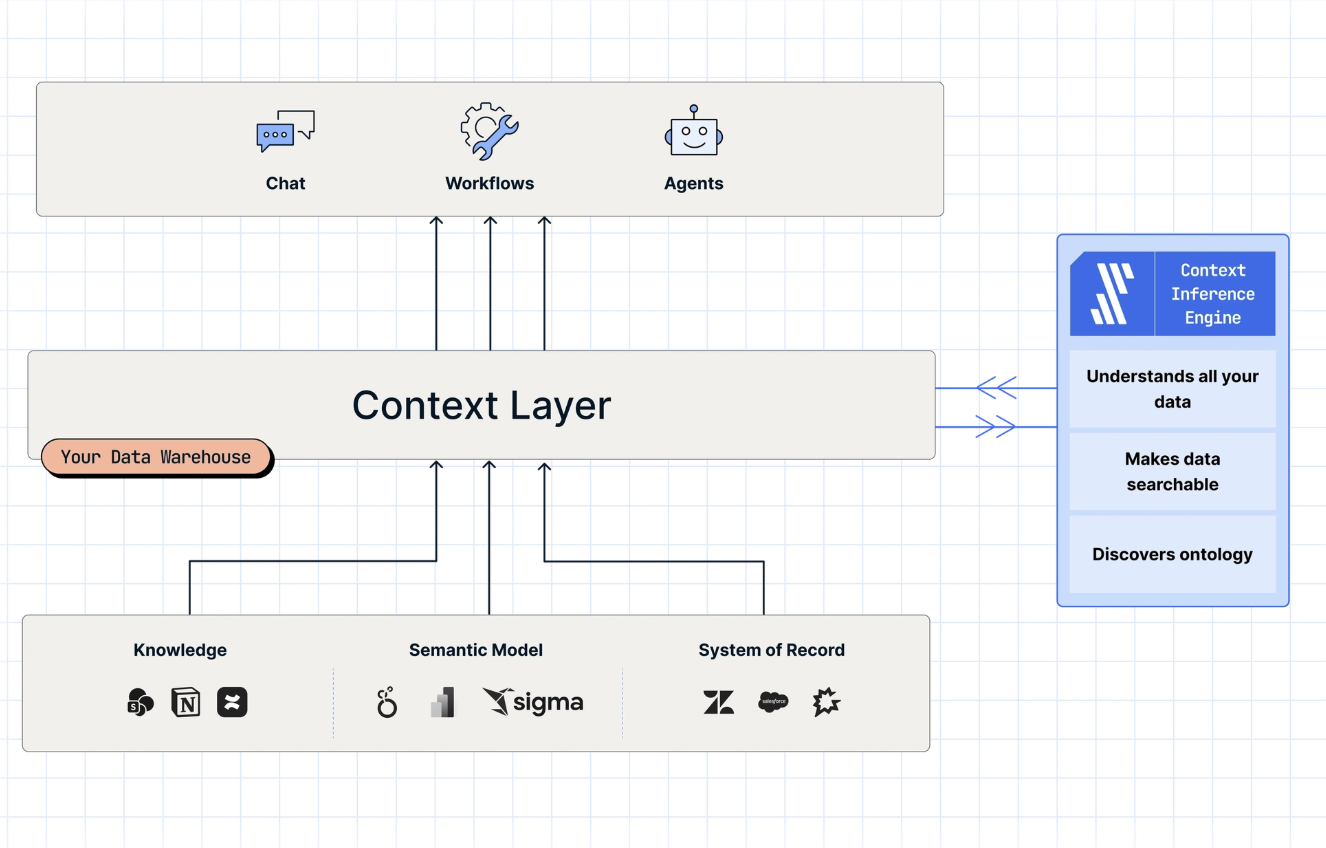
That's why we're excited to introduce Fivetran Context Layer, now in Limited Public Preview. Fivetran Context Layer is a managed service that jumpstarts the development of your governed context layer. Build and maintain it directly in your own data warehouse, or in Fivetran Managed Data Lake Service, and serve the right context to any agent that needs it. Rather than a separate system to stand up and maintain, it runs on the data and metadata Fivetran already moves and dbt already models. The result is agent outputs your teams can trust while reducing token costs at the same time.
Turn your data warehouse into your context layer.
Unify agent context in your warehouse
Most teams wire off-the-shelf tools and built-in AI features straight to raw data sources. Demos work but fall apart under scale and scrutiny.
Consider what an agent actually needs to answer, "What was revenue growth for our top 3 Majors accounts in the Northeast last fiscal year?" It needs to:
- Know how your company defines a Majors account.
- Resolve "revenue" to one governed dataset out of the several that claim the name.
- Constrain to your fiscal calendar rather than the standard one.
And to go beyond the numbers and develop hypotheses behind why the numbers are the way they are, or recommendations to change them, it needs to combine an analytical query with knowledge that only exists in messy, unstructured sources you’ve never modeled before.
Miss any of those, and an agent’s output looks plausible until an error surfaces later on, usually in front of someone who matters.
Fivetran Context Layer builds that context where meaning gets assigned — from the sources you’re already ingesting and as you’re modeling them in dbt — instead of after the fact.
The payoff shows up in 3 places:
- Accuracy improves, because a definition gets resolved once and inherited by every agent instead of reinvented per tool.
- Costs fall, because an agent that knows where to look retrieves one governed row instead of scanning an entire source.
- And governance stops being an afterthought, because context lives in your warehouse under the access controls you already enforce.
Key features and benefits
- Metadata connectors: Ingest metadata and context from semantic layers, including the dbt Semantic Layer, and from sources like Looker, Sigma, and Power BI, so existing semantic investment carries forward instead of getting rebuilt.
- Lineage and ontology discovery: Discover the concepts and ontology already implicit across your metadata sources, wikis, and connected applications and draft them into an ontology in your own vocabulary. No manual mapping project required.
- Search-optimized data connectors: Parse and index unstructured knowledge from Confluence, Google Drive, Jira, Zendesk, and more, so agents and machines can read and act on this valuable source of context.
- Agents Schema: Publish context into plain SQL tables following a unified, open-source specification directly in your warehouse. Agents navigate all of your entities accurately and efficiently without locking you in. Your context can evolve with you as your AI stack evolves.
- Agent Context MCP: Serve that context through a single governed interface to the tools your teams already use — or let any agent with SQL access read the tables directly, no integration required.
- Traces and evals: Write agent sessions back to your warehouse with a full trace: the answer, the SQL or document behind it, and the assumptions the agent had to make to get there. Review and verify the quality of your Context Layer as it’s being used in real time.
Fivetran Context Layer was born out of our own needs at Fivetran + dbt Labs, powering our primary internal AI assistant that helps employees find and synthesize company knowledge, query internal data, generate charts, schedule recurring reports, and so much more.
Even with this service in its early stages, we’re already seeing the benefits of unifying context in one place to power agents. Using internal evaluations against generic MCPs, agents that use Fivetran Context Layer make fewer tool calls and return answers faster while using significantly fewer input tokens. Better context means less hunting and fewer mistakes.
Join the waitlist today
With Fivetran Context Layer, we’re building the foundation for agents your business can trust.
Fivetran Context Layer is currently in Limited Public Preview, and we are actively looking for design partners to shape how this service works today and to provide insights into what an open context layer should provide in the future.
If you’re an existing Fivetran customer centralizing data with Snowflake, BigQuery, or Fivetran Managed Data Lake Service, and have AI use cases you’re looking to advance with improved reliability and cost, we want to hear from you.
[CTA_MODULE]
Related blog posts
Start for free
Join the thousands of companies using Fivetran to centralize and transform their data.