Unlocking the agentic enterprise with Open Data Infrastructure


Consider work that, until recently, routinely required 3 analysts working for 3 weeks: sourcing the data, reconciling competing definitions, building the model, validating the outputs, and assembling the final deck. An agent connected to properly governed data can now produce a credible version of that same deliverable in an afternoon.
That is real progress. But it creates a fundamental problem for an industry that has historically priced work by the hour, the headcount, or the amount of effort involved. The labor required to produce the analysis has collapsed; the client’s need for the analysis — and the business value of getting the right answer — has not. When the cost of producing the work falls by an order of magnitude while the value of the decision it informs stays roughly constant, the old pricing model stops making economic sense.
The industry’s own research is unusually candid about what is coming. BCG says plainly that longstanding delivery models will come under pressure as enterprises adopt systems capable of planning and executing entire processes autonomously. PwC describes the traditional consulting pyramid giving way to an hourglass. Many consultancies identify high-volume, low-complexity work — including managed services and staff augmentation—as among the areas facing the sharpest near-term pressure. For two decades, technology services have largely been sold on the scale of effort: more engineers, more analysts, more hours, more revenue. That proposition is now being marked down — and the people marking it down are the industry’s own customers and advisers.
And yet demand for these services has rarely looked stronger. Gartner estimates that more than 60% of organizations intend to deploy AI agents within 2 years, while only 17% have done so today. BCG’s research — based on 115 enterprise executives and 75 executives at service providers — estimates as much as $200 billion in net-new value pools over the next 5 years. More revealing still, two-thirds of enterprises expect providers, rather than their own employees, to operate their priority agentic AI use cases.
The money, in other words, is there. What has changed is what enterprises are willing to pay for. They have looked at the work, decided they do not want to build the capability themselves, and are prepared to spend heavily to get the outcome. But they increasingly have little reason to pay for the human effort that historically produced it. The question is no longer whether enterprises will buy these services. It is what, exactly, they will be buying — and whether the firms built around selling effort can reinvent themselves quickly enough to capture that spend.
[CTA_MODULE]
The work is context, and closed stacks make it unsellable
Consultancies will not be hired to supply intelligence. Frontier AI laboratories have done that, cheaply, already. The scarce resource is context: knowing what the business means, what its systems permit, and what an agent is actually allowed to do. That scarcity is becoming visible in the failure rate of agentic AI: Gartner expects more than 40% of such projects to be abandoned by the end of 2027, for reasons that are strikingly mundane. Here are just a few examples of what happens when agents are given the ability to act without the context to act reliably.
- In 2024, a Canadian tribunal ordered Air Canada to compensate a passenger after its chatbot invented a bereavement-fare policy that did not exist because it could not access the policy it was supposed to cite.
- In July 2025, a Replit coding assistant deleted a production database during a code freeze because it lacked a reliable boundary around what it was allowed to do.
- Klarna, after claiming its AI agent was doing the work of 853 employees and saving $60 million, was later described as a “poster child for bad AI deployments” as service quality deteriorated and human workers were quietly rehired.
None of these failures was primarily a failure of reasoning. They were failures of context. However, that is the pattern.
Around 80% of enterprises cite data quality as their principal obstacle to AI adoption; Fivetran’s readiness index found only 15% fully prepared, despite most having already committed tens of millions. The reason is that preparing data for AI is not just a technical exercise — it requires understanding the business context behind it. And that context is difficult to automate.
For example, it requires sitting with a business to establish what counts as a customer, which of 4 competing margin calculations governs decisions, or which definition of churn the board actually uses. It is judement, negotiation, and institutional archaeology — the least compressible work in the technology consulting portfolio.
Except there is a second problem. That judgement cannot create much value if it is trapped inside a single vendor’s proprietary stack. It cannot be governed end-to-end, arbitraged across platforms, or readily reused for the next client. The work is done once, billed once, and left behind. A closed stack does not merely inconvenience the client; it turns the $200 billion opportunity back into billable hours.
Open Data Infrastructure is the answer
The constraint on the agentic enterprise is not intelligence but infrastructure — and infrastructure is where consulting margin has always hidden in plain sight.
What is required is what Fivetran + dbt Labs call an Open Data Infrastructure (ODI). At its center is an open, governed foundation: a data lake built on open table formats, such as Apache Iceberg or Delta Lake, whose shared structure, metadata layer, and transaction model let multiple engines read and write the same data safely. Storage decouples from compute, so a client stores once and picks the best engine per workload — Snowflake, Databricks, GCP, or a compute engine not yet released.
Above it sit 3 things that matter more to an agent than to any human analyst:
- Lineage, which says where data came from and whether it can be trusted.
- A semantic layer, so humans and agents interpret "revenue" identically.
- Governance, which determines what an agent may see, decide, and change.
Together, they turn an agent from a demonstration into an auditable workflow.
As a result, 2 client freedoms follow. Because the business logic sits in the open foundation rather than inside any single engine. A client can run Snowflake today, add Databricks where it suits the workload, and move again later without rebuilding its definitions. And because the data is not surrendered to any vendor, a client can adopt Databricks Mosaic AI, Snowflake Cortex, Google Vertex AI, or Amazon Bedrock — or several at once — on its own terms.
Those freedoms are not just architectural advantages; they define where the $200 billion opportunity can be captured across 3 service lines built on an Open Data Infratructure:
- AI workflow design requires modelling data for agent consumption rather than for a dashboard — a discipline clients cannot buy as a product — and one that yields many small governable agents rather than a monolith.
- AI cost architecture, or next-generation FinOps, is the least contested territory on the map because almost no firm has staffed it; its levers depend on being able to route work between engines and models. A better-described data model sitting on Open Data Infrastructure is a cheaper model to reason over.
- Governed AI deployment will command the premium: roughly one fifth of enterprises have mature agent governance and around half of departmental initiatives run with no oversight at all, just as European AI Act obligations begin landing on a timetable clients do not set. The World Economic Forum's work with Capgemini on agent capability and authorization profiles is becoming the yardstick. Governance cannot be procured. It sits at the intersection of lineage, metric definition, access design, business policy, and regulatory interpretation. Tooling supports it; consultancies deliver it.
Selling into that means knowing where a client actually stands because most agentic conversations fail while the client is still short of the trailhead. Place the account on a ladder: from scattered logic and demonstration-ware agents, through version-controlled transformation and visible costs, to definitions centrally owned in a semantic layer where the cost curve turns, and finally to machine-readable governance. Clients cannot skip rungs, and most are trying to. Naming that gap is itself a billable service, and a diagnostic is easier to sell than a transformation.
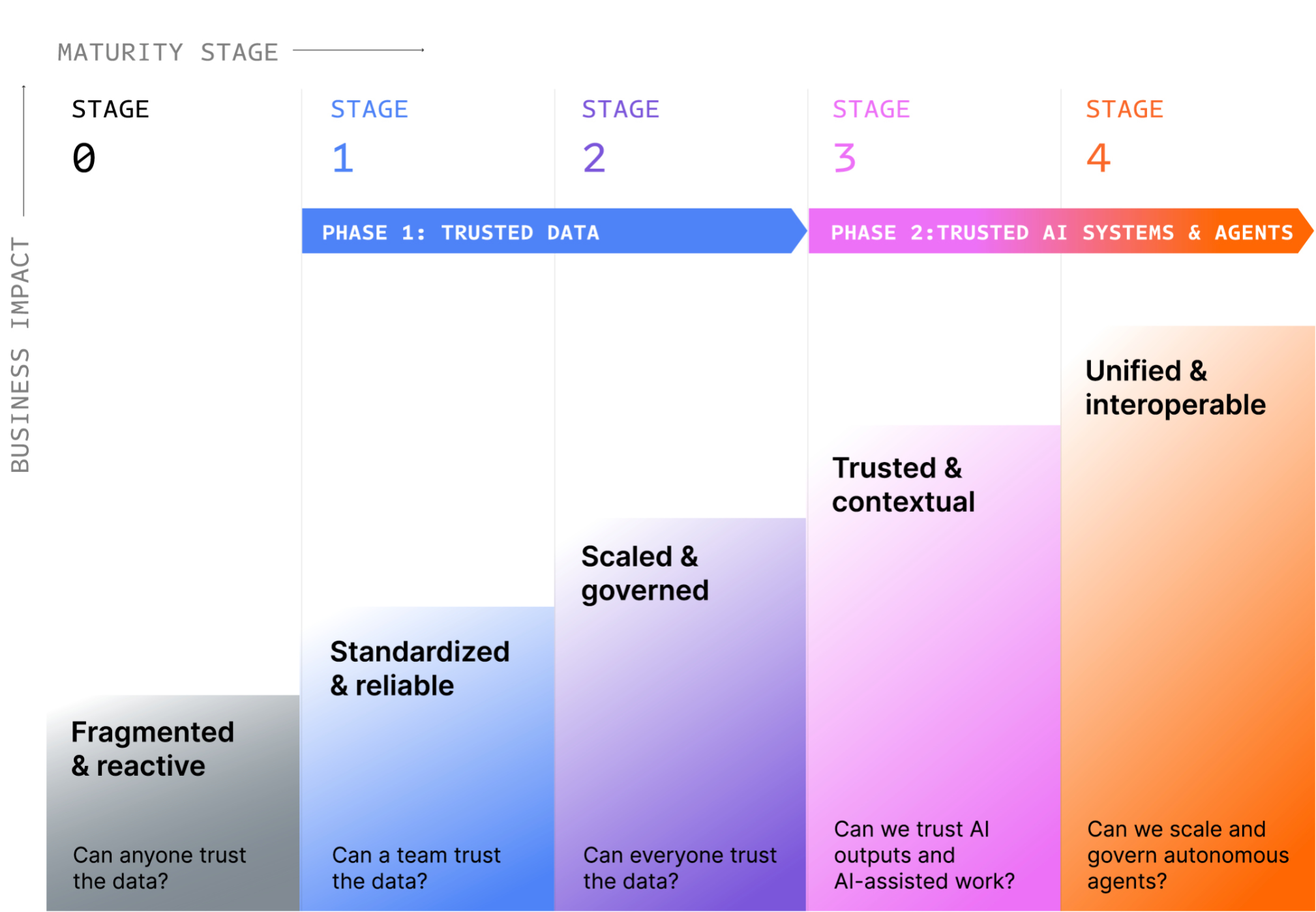
Once the gap is visible, the next step is to turn the firm’s accumulated knowledge into something reusable. Not internal productivity gains that simply mean fewer hours billed for the same work, but asset formation. A pattern developed once on Open Data Infrastructure and deployed across fifteen accounts is intellectual property — and intellectual property is priced on the value it creates, not the hours required to produce it.
The most valuable assets are reference architectures, because the path from fragmented data to an exposed semantic layer is structurally similar across companies in the same sector; agent patterns, because a relatively small number of proven designs will cover most viable early use cases; and, most importantly, skills and instructions: portable, versioned representations of the judgement that has historically walked out the door when a senior consultant leaves.
That changes the economics of the firm. Each engagement can improve the asset, and each new deployment can generate value without recreating the underlying work from scratch. A firm that captures its delivery judgment this way is building an asset that compounds. A firm that does not is simply renting its own expertise.
Your three moves this quarter
Openness is usually filed under architectural hygiene. File it under commercial strategy.
An Open Data Infrastructure is what makes context governable for the client and resellable for the systems integrator, and it is the difference between capturing a share of the $200B and billing hours against it. Three moves follow:
- Place one account honestly on the maturity ladder, and sell the diagnostic before the transformation.
- Build its first agent workflow on an Open Data Infrastructure — open table formats, transformation at the destination, a semantic layer the agent reads from.
- Package what you learn as a reference architecture, an agent pattern, or a skill and price it as intellectual property across the next 3 accounts.
Context, not model access, is the only thing standing between your clients and the outcomes they have already announced. And repeatable IP on an Open Data Infrastructure accelerates customer outcomes and your consulting margins.
[CTA_MODULE]
Related blog posts
Start for free
Join the thousands of companies using Fivetran to centralize and transform their data.