How to use Fivetran Skills to connect Claude to your Marketo data


Conversational analytics, enabled by generative and agentic AI, has been gaining traction because it allows teams to explore data through an ongoing conversation rather than a series of manual, one-off investigations. I saw the need firsthand at Fivetran and dbt Labs. Our Marketo data was already sitting in the warehouse, but until recently, answering questions about nurture performance was a lengthy, manual process. A question as simple as ‘Where are people dropping out of this nurture?’ could take days of building Smart Campaigns and reports in Marketo, even though the data to answer it was already in our warehouse.
Fivetran Skills closed that gap for me. I can ask questions about our Fivetran-synced data directly, in plain English, without building a new report or waiting on a data engineer to write a query for me. And since the interface is through Claude, which I already use, there was no new tool to learn and no change to how our data or warehouse is set up.
I’ve used this to troubleshoot Marketo campaigns that used to take me days, now down to minutes.
[CTA_MODULE]
What is the Marketing Automation Analysis skill?
A skill is a folder of instructions that teaches an AI agent how to do a specific task. Anthropic created the format, but because it’s popular and works well, it has been adopted by other agents like Codex and Cursor. In Anthropic’s own testing, Claude’s accuracy on analytics questions went from 21% without skills to over 95% with them
Our team designed Fivetran Skills to go beyond just instructions. Fivetran builds both the connectors and the dbt models on top of them, so each skill contains strong knowledge of the schema and how the models fit together. That lets the agent give correct answers instead of guessing from column names. Every answer comes from a SQL query against your warehouse, so you can easily check the query to validate the results. Since we know this data well, we also built templated dashboards based on best practices for each data source.
For example, the Marketing Automation Analysis skill, which I used for my analysis, knows Marketo data well. It knows how leads move through funnel stages, how programs and nurtures are set up, and how email engagement is tracked. That includes details like opens and clicks on the lead record being lifetime totals, so the skill calculates rates for a specific period from the email send history instead.
How I deployed the skill
The skill is very easy to set up. Before you start, you need Marketo data already syncing into BigQuery, Snowflake, or Databricks with Fivetran, and an AI agent that supports skills, such as Claude Code. Deploying the Fivetran Marketo Quickstart Data Model is optional, but it gives the skill a cleaner layer to work from than raw connector output.
Step 1: Install the Marketing Automation Analysis skill
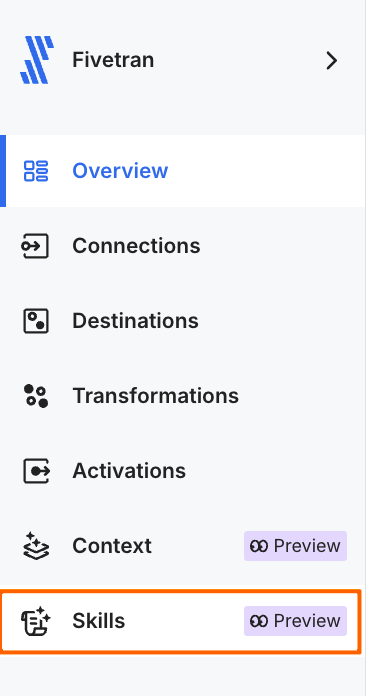
In Fivetran, open Skills from the left-hand navigation and select Marketing Automation Analysis. The page shows whether your Marketo data has the tables the skill needs. Click Install and follow the steps for your agent.
Step 2: Complete first-run configuration
The first time you ask a question, the skill asks whether you know which warehouse your Fivetran data lands in.
- If you do, give it the warehouse type and database name, and it finds your Marketo data on its own. No API key is needed.
- If you don’t, it walks you through setting up a Fivetran API key instead.
Either way, it saves your setup, so you only do this once.
Step 3: Ask a question
There is no special query syntax required. I just ask in plain language, for example: “Where are leads dropping off in the funnel?”
My use case: Troubleshooting a complex nurture program
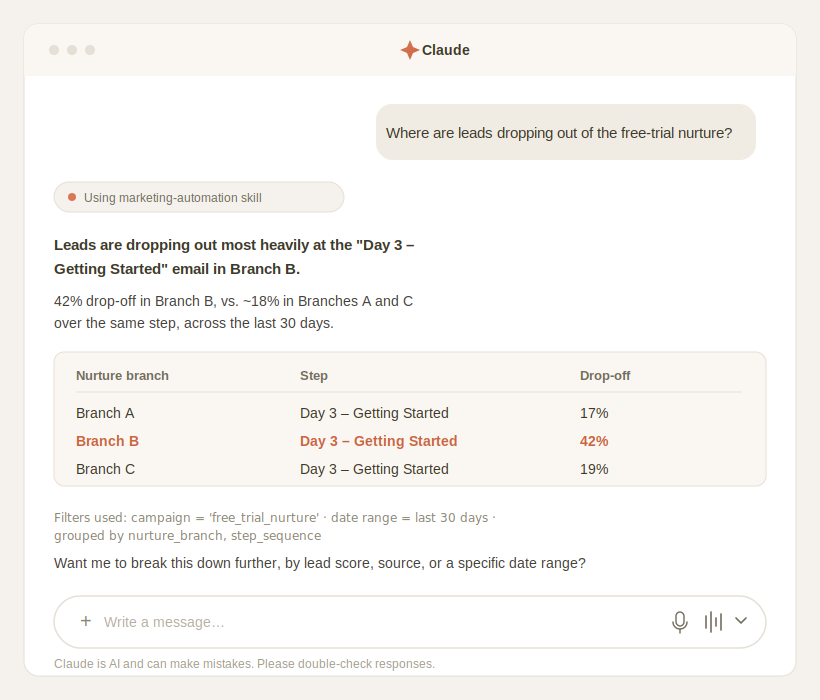
A multi-branch free trial nurture wasn't behaving as expected. With nested campaigns feeding into each other, the failure wasn't obvious from the top-level program, and pinning down where leads were dropping out meant tracing branches one by one.
Before the skill, diagnosing something like this meant building the Marketo artifacts I needed to isolate the problem: Smart Campaigns, lists, reports, then inspecting the results, refining, and repeating. That process could take days, sometimes weeks, depending on how deep the issue was buried.
With the skill, I start the same investigation with a direct question against our Marketo data already synced into the warehouse:
- "Where are leads dropping out of the free trial nurture?"
- "Break that down by nurture branch."
- "Which campaign step has the largest difference between expected and actual progression?"
The skill queries the warehouse directly and returns both the answer and the filters it used to get there, so I can sanity-check the result against something like the Activity Log rather than taking it on faith. What used to take me days or weeks of manually building reports now comes down to minutes or a couple of hours.
The same skill that answers “why is this campaign broken?” works just as well for broader analysis questions I’ve asked since: where performance is strongest, which region is outperforming expectations, and so on, without rebuilding analysis infrastructure for each new question.
Connect AI to the data you already trust
Fivetran already solved the first problem for us: getting Marketo data reliably into the warehouse and transforming it into modeled and trustworthy data sets. Fivetran Skills solved a different one for me: making that data usable, in plain English, by people who don’t need to understand the schema.
Two things I’d tell any data team:
- Centralizing data isn’t optional, even for AI. Connecting Claude directly to an application for analytics doesn’t scale. It hits the same data volume and missing-context limits I ran into when I tried to answer these questions from Marketo directly. The data needs to be governed and modeled before Claude can reliably answer questions with it.
- Once that foundation exists, a skill can turn it into a self-service layer for any team, not just marketing operations. The investigation that used to take me days or weeks of manually building reports and lists is now a conversational back-and-forth against data that was already there.
You can see all the skills we support here.
[CTA_MODULE]
Related blog posts
Start for free
Join the thousands of companies using Fivetran to centralize and transform their data.