The cost of AI without connected data



Companies are investing heavily in AI, but a significant share of that spending never reaches innovation. Instead, it pays for work that should not have been necessary in the first place: fixing data quality issues, rebuilding integrations, reprocessing data, and retraining models.
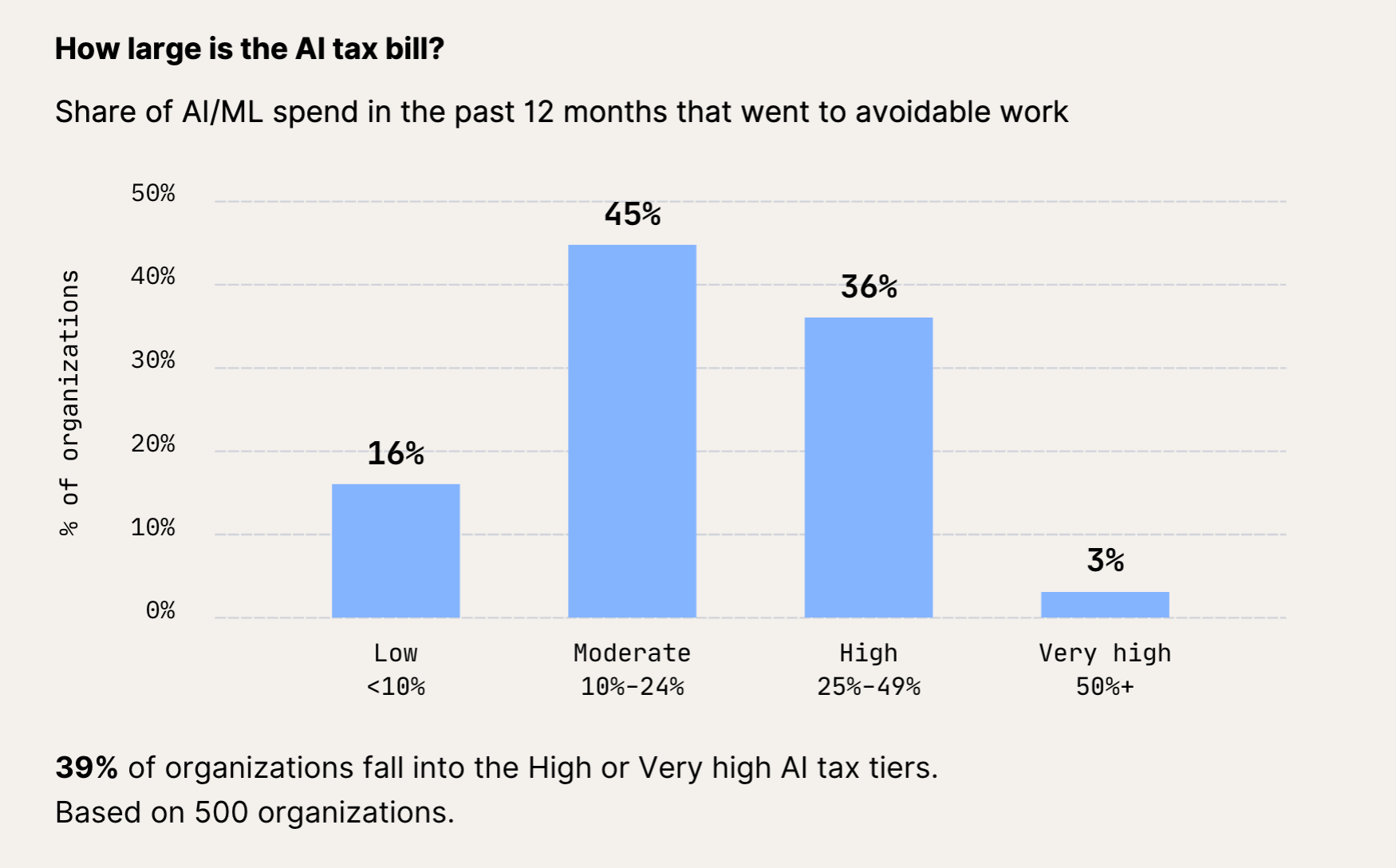
New Fivetran research calls this avoidable cost the AI tax because in a survey of 500 senior IT, data, and AI/ML decision-makers, 39% said at least a quarter of their AI/ML spending went to avoidable work over the past 12 months. Only 16% keep the AI tax below 10%.
The budgets at stake are substantial. More than 80% of organizations spent at least $1 million on AI/ML during the past year, and 54% spent $5 million or more. Yet only 37% have multiple initiatives live in production and operating at scale.
The findings reveal a widening gap between investing in AI and building the connected data foundation required to make that investment productive. Organizations with a high AI tax do not just spend more correcting problems. They are also far more likely to experience stalled projects, longer delays, and weaker returns.
[CTA_MODULE]
The AI tax starts in the data foundation
The study defines the AI tax as the share of AI/ML spending consumed by avoidable rework. That work can appear across an initiative, but 66% of respondents traced unexpected work, delays, or costs to two areas: data quality and data integration.
The impact extends beyond the budget, with 58% of respondents saying their technical teams spend at least a quarter of their AI/ML time on avoidable rework. Moreover, 66% discovered their initiatives required moderately or significantly more data work than planned once those projects were underway.
In addition to taking up the technical team’s time, poor-quality data also produces consequences that business leaders can see. Nearly every organization surveyed had experienced at least one negative outcome from running AI on poor data. And 57% reported inaccurate outputs or predictions, while the same share had to retrain or recalibrate models. Across every region surveyed, 51% to 54% said poor data caused stakeholders to lose trust in AI outputs.
Those costs can be difficult to identify because they are scattered across projects, teams, and budgets. Only 38% of respondents track the full cost of AI-related data work centrally and consistently. Without that visibility, organizations may attribute missed timelines or disappointing returns to the model while overlooking the integration and data-quality work consuming resources underneath it.
A high AI tax is closely associated with project delays
As the AI tax rises, the likelihood of significant delays rises sharply with it.
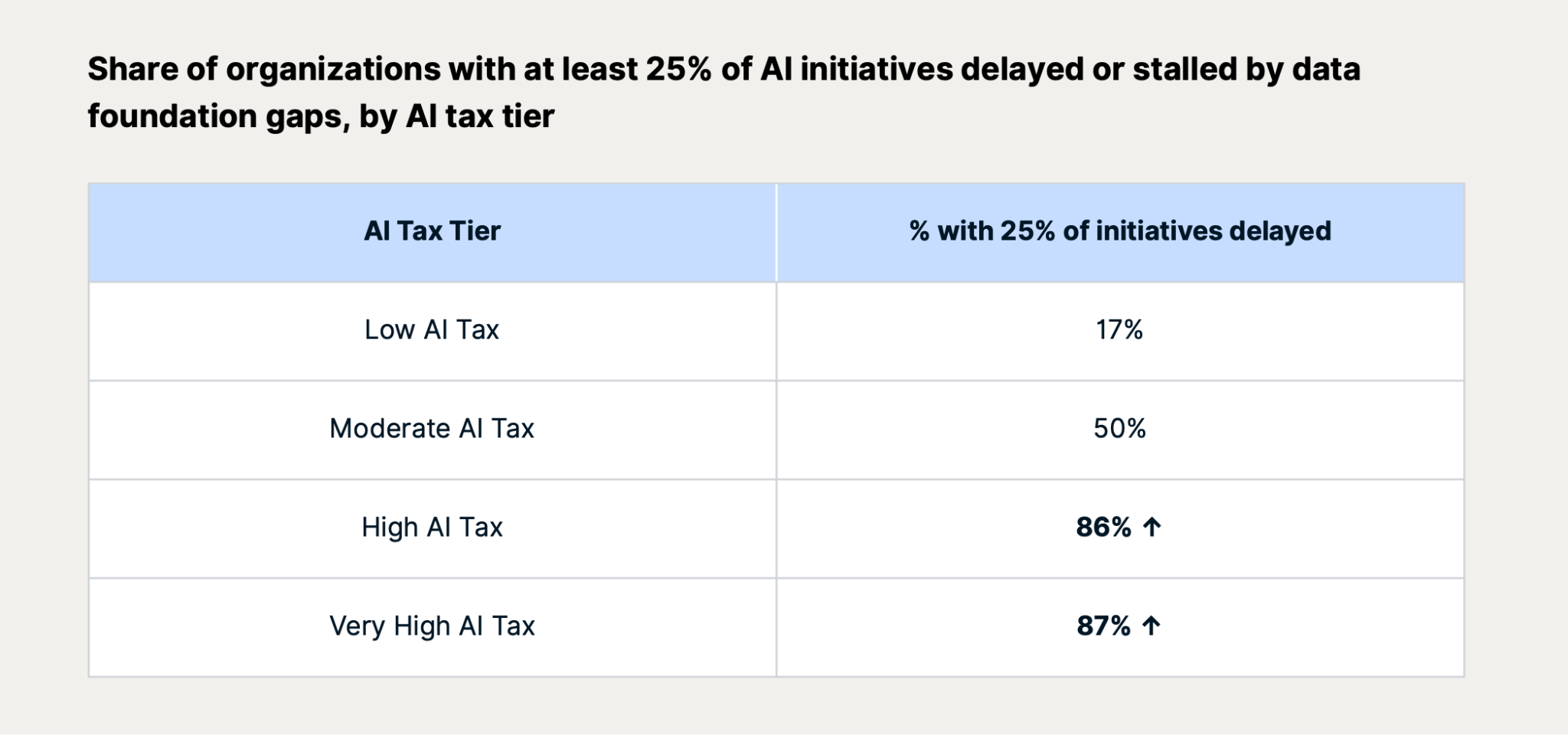
Among organizations with a low AI tax, 17% said at least a quarter of their AI initiatives had been delayed or stalled by gaps in the data foundation. That figure climbs to 50% among organizations with a moderate AI tax and 86% among those with a high tax. In other words, organizations with a high or very high AI tax are about 5x as likely as those with a low tax to have at least a quarter of their AI initiatives delayed or stalled.
Those delays also last longer. Seventy-six percent of organizations in the high-tax group said delays typically persist for 3 weeks or more, compared with 46% of organizations in the low-tax group.
The same pattern appears in reported outcomes. Sixty-two percent of low-tax organizations said AI ROI exceeded expectations, compared with 40% of organizations in the very-high-tax group. Low-tax organizations were also more likely to outperform expectations when moving initiatives into production and scaling them across the business.
The pattern is clear: organizations spending more on avoidable data work also report substantially more delays and less success turning AI investment into business value.
Custom integration is one of the clearest dividing lines
How companies connect their data is closely associated with the size of their AI tax.
Among organizations relying primarily on custom, project-specific integrations, 53% reported spending at least a quarter of their AI budgets on avoidable work, compared with 40% of organizations using standardized integration platforms.
The lowest share — 35% — came from organizations using a standardized platform while reserving some custom development for specialized needs. The finding does not suggest companies should eliminate custom work. It suggests that custom integration becomes expensive when every AI initiative rebuilds its data foundation from the ground up.
A shared integration platform gives teams a consistent way to move and manage data across projects. Custom development can then be reserved for the exceptions that genuinely require it, rather than becoming the default for connecting every source, model, and application.
That distinction becomes more important as AI adoption expands. One custom pipeline may solve one project, but a growing portfolio of agents, models, and applications needs a reliable foundation that can continuously supply fresh, governed, and consistent data without recreating the same integration work each time.
How data leaders can lower the AI tax
The findings point to 3 priorities for organizations that want more of their AI spending to reach production and generate value.
- Standardize the integration foundation: Treat data integration as shared infrastructure rather than a separate build for every initiative. Standardize the common work of connecting, moving, and maintaining data, while preserving custom development for use cases that need it. This reduces repeated engineering effort and gives new AI projects a dependable place to start.
- Make the full cost of data work visible: Include data preparation, integration, reprocessing, and maintenance in AI business cases from the beginning. Track those costs consistently across teams and projects so leaders can see where avoidable work is consuming budget and engineering capacity. The AI tax can then become a measurable operating metric rather than a hidden cost discovered after timelines slip.
- Clarify ownership and align on outcomes: Establish clear accountability for the data foundation and align technical and business teams on how AI success will be measured. Forty-two percent of respondents cited unclear ownership or cross-team misalignment as a reason initiatives stall or underperform. Organizations reporting strong alignment were more than twice as likely to say ROI exceeded expectations as those reporting misalignment.
Redirect AI spending from rework to results
Companies already recognize the opportunity. If their AI/ML budgets increase during the next 12 months, 31% would direct additional investment to the data foundation — more than any other category. Forty-one percent estimate that eliminating avoidable data work could improve AI time to value by more than 25%, and nearly 9 in 10 expect an improvement of more than 10%.
As enterprises move from AI experimentation to production, the challenge is no longer simply building models. It's ensuring those models and agents have continuous access to fresh, reliable data, with the context needed to produce trustworthy outcomes.
Fivetran helps companies lower the AI tax by automating data movement across 750+ sources and delivering fresh, reliable data to the platforms where analytics and AI happen. With a standardized integration foundation, technical teams can spend less time repairing pipelines and recreating data access — and more time putting AI into production.
[CTA_MODULE]
Related blog posts
Start for free
Join the thousands of companies using Fivetran to centralize and transform their data.