Open Data Infrastructure keeps your options open


Open Data Infrastructure (ODI) is an architectural approach predicated on storing data once in a data lake in open formats and using it anywhere — across tools, compute engines, and AI systems — without being locked into a single vendor. With ODI, companies can build a unified data foundation to support every foreseeable data use case.
Interoperability is a key element of ODI. At a glance, interoperability may sound like an abstract technical aspiration — the ability to use modular, interchangeable components and build elegant, composable systems. However, this framing ignores the key benefit of interoperability: freedom of action. It is the ability to change one element of data architecture without changing everything else.
[CTA_MODULE]
When convenience turns into dependency
Managed services of all kinds, such as applications, data platforms, infrastructure, and integration platforms, offer extensive benefits to their customers by allowing them to automate or outsource operations and infrastructure functions that sit outside the core expertise of the business. They can simplify procurement processes, save technical resources, and minimize setup friction. Fivetran is itself a managed service that automates data integration and the management of data lakes.
However, this convenience only remains an unalloyed good as long as the costs of switching to another system remain manageable. Providers of managed services may create dependency and high barriers to switching through various means:
- Coupling compute and storage, as in traditional data warehouse architectures
- Proprietary data formats, query languages, and other closed standards
- Contractual stipulations and technical barriers against data portability
- Bundling disparate services, such as cataloging, workflow orchestration, and AI tools, together under a common platform
These challenges lock customers into dependency that can be difficult or costly to reverse, leaving customers with few options for multiple, sophisticated use cases.
These challenges also limit customer leverage as new use cases emerge and technologies, markets, and industries rapidly change. In the medium and longer terms, there is also no way for any company to know which engine will dominate, how AI workloads will reshape data access patterns, or how pricing models will evolve. What is certain is that change is inevitable, and that organizations have a strong interest in avoiding penalties for adapting to changing circumstances.
Interoperability means optionality and leverage
ODI gives teams optionality and leverage because each layer can evolve independently: storage, table formats, catalogs, governance, compute, query engines, AI workloads, and downstream applications.
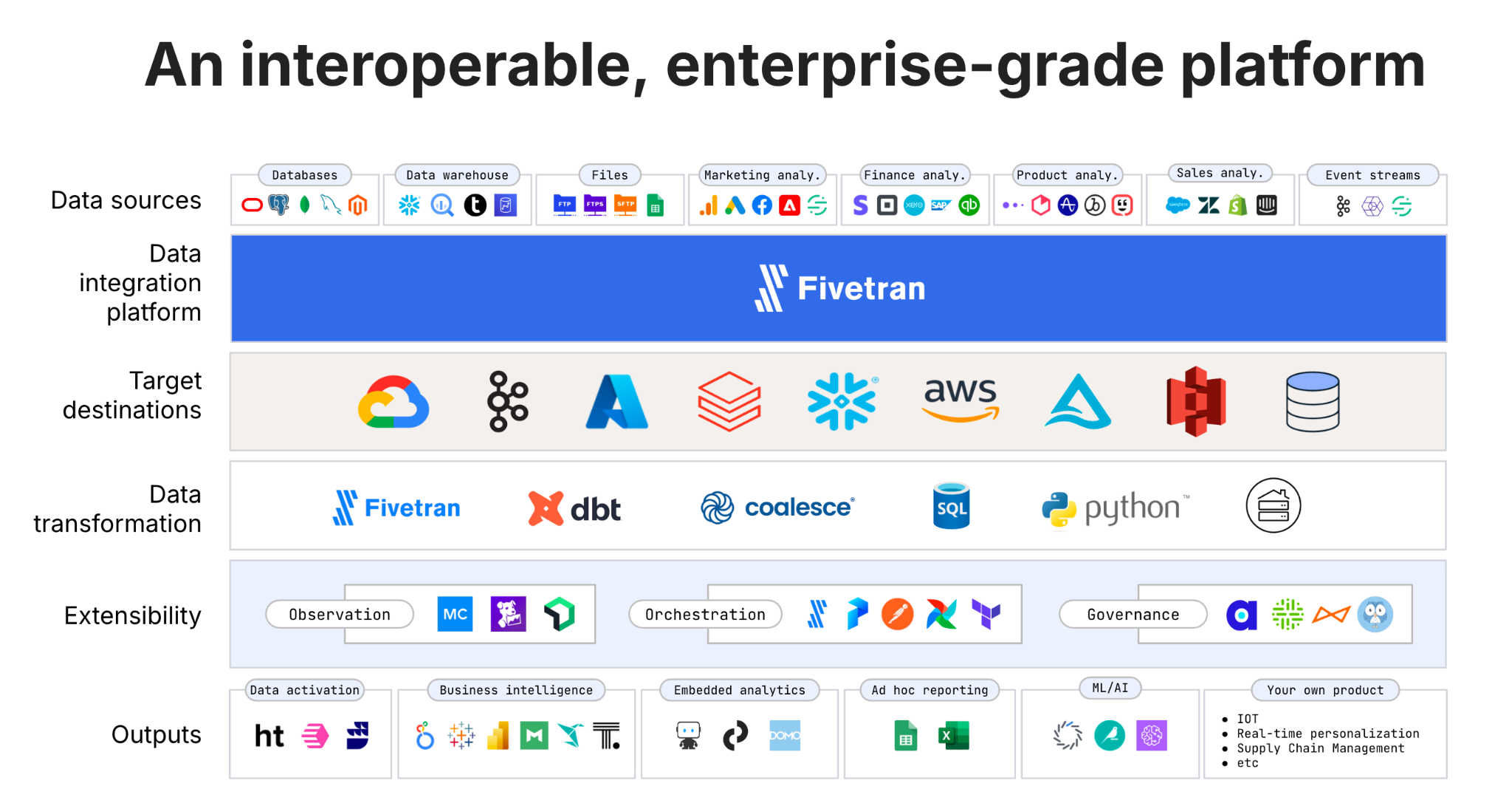
Open standards are the key to interoperability, allowing independent components to perform as more than the sum of their parts.
- Open table formats allow multiple engines to work over the same data.
- Shared metadata and catalogs ensure a unified semantic layer and reduce duplication.
- Interoperable query and compute engines let teams match execution to workload.
- Open interfaces prevent the data layer from being trapped behind a single platform boundary.
Organizations may field multiple use cases at once, each requiring different capabilities:
- Reporting and BI through dashboards need fast, structured queries and low latency.
- AI and ML may need to support both structured and unstructured data and unusual or experimental compute patterns.
- Streaming or operational use cases introduce stringent freshness and performance needs.
- Handling large batches of data requires prioritizing cost efficiency.
Without interoperability, organizations are likely to produce sprawling, duplicative, complex data infrastructure with multiple, often conflicting copies of the same data, spiraling storage costs, and impractical governance complexity.
By contrast, ODI means loading data once and the optionality to mix and match tools for every use case as needed. Ultimately, companies that embrace interoperability stand to gain 3 forms of optionality and leverage:
- Technical leverage: Opportunities to adopt better tools without rebuilding the foundation.
- Economic leverage: The choice of lower-cost or higher-performance tools for different workloads.
- Strategic leverage: Independence from a single vendor’s roadmap, abstractions, or pricing power.
How to balance interoperability with convenience
Interoperability is not, of course, free. An interoperable infrastructure can be poorly designed, become unmanageable, and produce excessive operational overhead. But the answer is not to only use tightly bundled platforms that make every architectural choice dependent on a single vendor. The answer is disciplined modularity: having a clear eye for the tradeoffs introduced by every tool or set of tools, and maintaining open standards, governance, and clear lines of ownership.
The key is not optionality for its own sake, but meaningful choice where it matters most: the ability to change compute engines, query layers, catalogs, or governance tools without losing control of the data itself.
With choice and leverage, data teams can continue to negotiate, optimize, experiment, and evolve as workloads, costs, and technologies change. ODI matters because it shifts power away from vendors and back toward data owners. Instead of forcing every workflow to conform to the assumptions of a particular platform, organizations can adapt their infrastructure to their needs while preserving freedom of choice over time.
[CTA_MODULE]
Verwandte Beiträge
Kostenlos starten
Schließen auch Sie sich den Tausenden von Unternehmen an, die ihre Daten mithilfe von Fivetran zentralisieren und transformieren.