Votre prochain personnel utilise des données : êtes-vous prêt pour cet avenir ?

Le passage organisationnel d'une institution humaine à un système informatique place les données au centre. Dans un système informatique, les données ne constituent pas un matériau de référence. C'est le matériau. Pourtant, depuis des décennies, les données sont au cœur de l'entreprise plutôt qu'à l'intérieur de celle-ci. Il a servi de miroir rétrospectif qui montrait ce qui s'était déjà passé, laissant aux humains le soin de l'interpréter et de décider de la marche à suivre. C'était la réalité pratique de « devenir piloté par les données », et cela dépendait entièrement de la motivation humaine, du temps humain et de l'interprétation humaine.
Agents d'IA changer complètement cette relation.
Lorsque le travail est effectué par des systèmes autonomes, les données cessent d'être facultatives. Les agents ne choisissent pas d'utiliser ou non les données. Les agents agissent sur elle, raisonnent à travers elle et dépendent de sa qualité pour agir correctement. Ils ont besoin de données au moment de l'action, ce qui les transforme en un support de transaction : le canal par lequel le travail est lancé, validé et terminé.
Dans ce monde, les données ne sont plus un tableau de bord que vous consultez. Il devient le substrat qui alimente le comportement de votre personnel agentique, ce qu'il apprend et ce qu'il peut faire. Il s'agit du passage de l'utilisation des données pour comprendre l'entreprise à l'utilisation des données pour la mener à bien.
Tout cela mène à une conclusion simple : si les agents dépendent des données pour agir, les organisations doivent créer un environnement lorsque ces données sont accessibles, interprétables et exécutoires au moment de l'action. Ce besoin devient le mandat architectural de la prochaine évolution de l'infrastructure de données.
[CTA_MODULE]
L'avenir de l'infrastructure de données
Un changement structurel est en cours. Au fur et à mesure que les flux de travail passeront de l'exécution humaine à l'exécution par les agents, l'ensemble de l'écosystème des données et des applications sera remodelé. Ce changement comporte 4 composants principaux, chacun remodelant une couche différente de la pile.
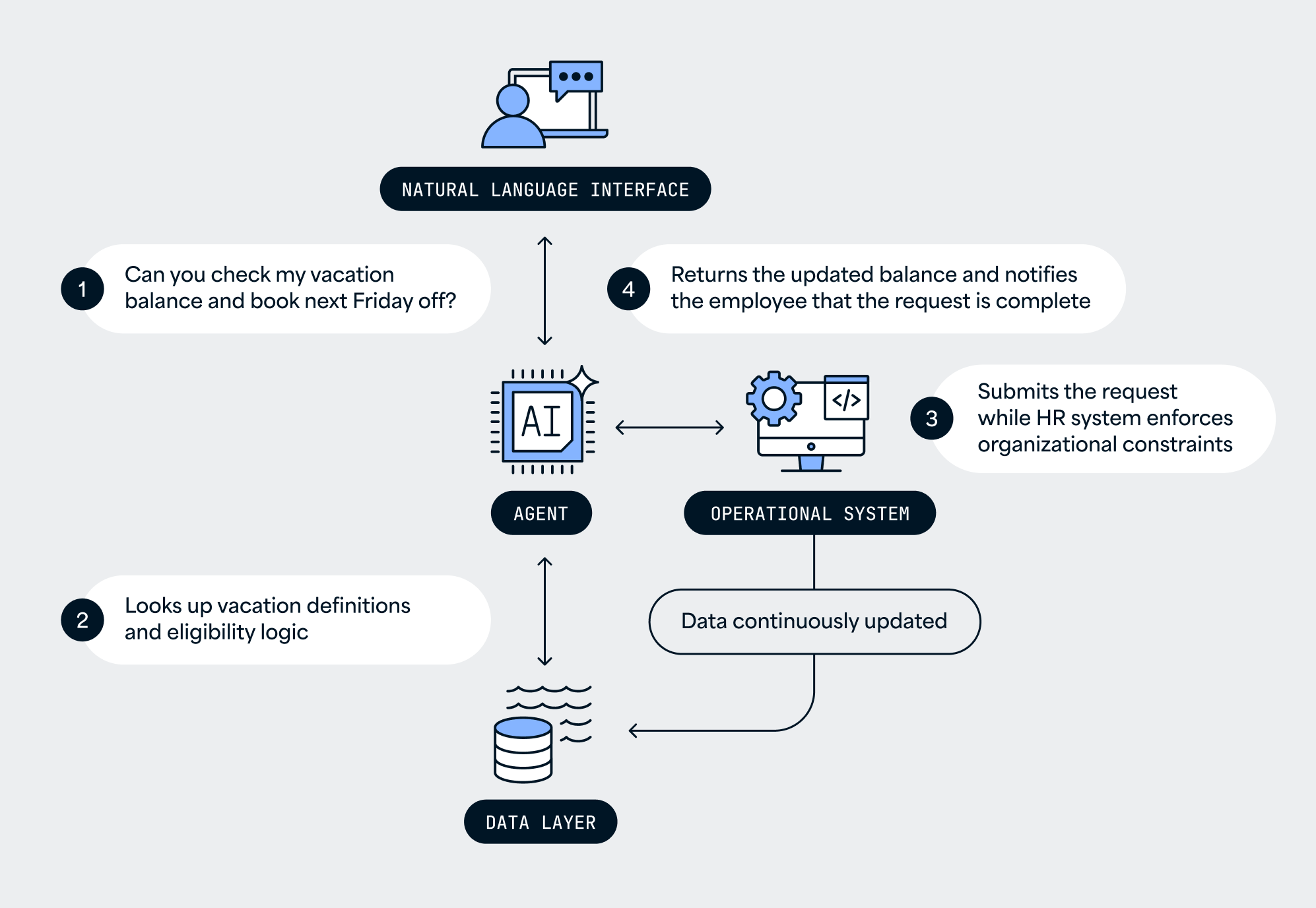
Interfaces en langage naturel ouvrira l'accès aux données à toute personne capable d'exprimer une question ou une instruction dans le langage courant. Aucune compétence spécialisée. Aucune courbe d'apprentissage. Aucun dépôt de tickets auprès d'une équipe chargée des données. Il s'agit du dernier obstacle à l'accessibilité des données que le secteur a eu du mal à surmonter.
Agents deviendra le mécanisme universel d'exécution des tâches, remplaçant les flux de travail opérationnels sur mesure qui dépendent de systèmes, de rôles ou de compétences techniques spécifiques. Au lieu d'utiliser des outils qui dictent la manière dont le travail doit être effectué, les agents effectueront le travail dans différents systèmes et contextes. Ils deviennent l'unité d'exécution des opérations de l'organisation.
Systèmes opérationnels et les applications métier ne seront plus le lieu principal où les humains effectuent leur travail ou où réside toute la logique métier. Leur rôle consiste désormais à appliquer les contraintes spécifiques au domaine qui garantissent le bon déroulement des opérations. Ils deviennent des environnements durables, orientés vers des règles plutôt que des interfaces utilisateur, régissant des définitions telles que ce qui est considéré comme un enregistrement valide, qui peut le modifier et ce qui doit être vrai avant qu'un système ou un agent ne soit autorisé à agir.
Le couche de données devient la couche opérationnelle du travail des agents, passant d'un enregistrement passif de ce qui s'est passé dans l'environnement dans lequel les décisions et les flux de travail se déroulent. Les piles de données actuelles ont été conçues pour les humains qui exécutent des requêtes, et non pour les agents qui orchestrent des flux de travail continus et automatisés. Les humains peuvent surmonter l'ambiguïté. Par exemple, si les finances et les ventes ne sont pas d'accord sur le chiffre d'affaires annuel récurrent (ARR), ils peuvent en discuter et décider du chiffre à utiliser pour le tableau de bord. Les agents ne le peuvent pas. Elles nécessitent des règles explicites, une priorité définie et une résolution des conflits au sein même des données.
Pour soutenir les opérations des agences, la couche de données doit évoluer de 4 manières critiques :
- Accessibilité universelle. Les données doivent être interopérables sur tous les systèmes de l'organisation.
- Une réponse canonique unique pour chaque concept de base. Ce n'est un secret pour personne que les responsables des données évitent ce poste depuis des décennies. C'est un événement délicat, politique et rarement célébré. Mais décider de la bonne réponse et de l'endroit où elle devrait se trouver n'est plus une option. Comme Jamin Ball a déclaré : « Les entreprises qui remporteront ce cycle seront celles qui proposeront des expériences agentiques incroyables en s'appuyant sur des sources de vérité ennuyeuses et solides comme le roc. »
- Contrats relatifs à la manière dont les données sont autorisées à être modifiées. Des limites claires garantissent que les agents agissent de manière prévisible et que les flux de travail restent stables.
- Définition explicite du sens et de la priorité. Les données doivent contenir les définitions, la logique et la propriété intellectuelle de l'organisation, afin que les agents puissent les interpréter et agir en conséquence sans médiation humaine.
L'architecture de données qui alimentera la prochaine ère du travail
Fivetran a passé plus de dix ans à rendre fiables et accessibles des données prêtes à être analysées. Le passage à l'IA introduit un ensemble d'exigences supplémentaires. Les systèmes d'IA ont besoin de bien plus que des tableaux bien modélisés. Ils s'appuient sur des données dont la provenance est traçable, une sémantique normalisée, une interopérabilité garantie et une disponibilité fiable au point d'exécution.
Dans l'ensemble de notre travail avec les entreprises, nous constatons la même évolution, et plusieurs capacités deviennent essentielles.
1. Des données de haute qualité, avec leur généalogie et leur historique
L'IA commence par des données fiables, fiables et bien structurées. Dans un environnement piloté par l'IA, cette base doit être associée à une compréhension de l'origine des données, de la manière dont elles ont été transformées et de leur évolution au fil du temps. Dans un état futur de Fivetran et de la dette, les entreprises bénéficieront d'une visibilité de bout en bout sur l'origine, les transformations et le cycle de vie de leurs données. Cela donne aux systèmes d'IA la capacité d'évaluer la fiabilité, de comprendre la provenance et de déterminer si les données sont adaptées à une tâche donnée.
2. Une transformation qui ajoute du contexte
Le sens ne provient pas des données en elles-mêmes. Il est créé à partir de modèles qui expriment le mode de fonctionnement d'une entreprise. Les données sont transformées, jointes et enrichies afin de refléter le fonctionnement réel de l'entreprise. Ce travail code la propriété intellectuelle de l'organisation, les connaissances tribales qui sont ancrées dans la tête des employés mais qui doivent être explicitement représentées pour que l'IA puisse les utiliser.
3. Une couche de données universelle que n'importe quel système peut consommer
Nous avons dépassé le stade où les outils de BI sont les seuls consommateurs de données. Les agents d'IA, les systèmes opérationnels et les outils émergents nécessitent tous un accès direct. Comme nous ne pouvons pas prévoir tous les outils ou modèles futurs, l'approche la plus résiliente consiste à stocker et à gérer les données dans un format universel. Une couche universelle assure la pérennité de l'entreprise et garantit que tout nouveau système peut être connecté sans travaux d'ingénierie personnalisés.
4. Accès opérationnel au point d'action
L'IA n'a de valeur que lorsqu'elle le peut participer auxflux de travail où les résultats sont déterminés. Si l'IA soutient les ventes, les finances ou le support, elle doit être en mesure de fournir des données fiables et enrichies directement dans les applications dont dépendent ces équipes. C'est ce qui fait passer l'IA du stade de conseil à celui d'opérationnel, de la suggestion d'actions à leur mise en œuvre.
L'avenir de l'agence est un mandat d'infrastructure
L'IA ne fournira pas d'avantage concurrentiel en raison des modèles qu'elle déploie, mais en raison des bases de données sur lesquelles ces modèles s'appuient. Les gagnants seront les entreprises qui construiront des bases stables, interprétables et interopérables bien avant l'arrivée de la vague agentique.
La future main-d'œuvre est déjà en train de se former. La question est de savoir si vos données sont prêtes à le supporter.
Pour les organisations qui se préparent à ce changement, nous sommes prêts à soutenir les bases de données qui le permettent.
[CTA_MODULE]
.svg)
Articles associés
Commencer gratuitement
Rejoignez les milliers d’entreprises qui utilisent Fivetran pour centraliser et transformer leur data.