AI requires unstructured data to unlock its full potential

Your current data movement pipelines are most likely ingesting structured data like CRM records, sales lines, marketing campaign performance data, and financial transactions into Snowflake, BigQuery, or Databricks for dashboards and reports.
Until recently, analytics stacks were designed to leverage structured data for dashboards and reporting, and most data pipelines were designed accordingly. If you're using Fivetran today, you’re already harnessing the power of our 750+ connectors to build your stack. The problem is that modern agentic AI systems need more than a data stack designed for humans - they need a data foundation built for AI.
Customer support tickets, contract PDFs, email threads, Jira descriptions, and case attachments contain valuable context for AI, yet largely live outside structured schemas. Most pipeline solutions only ingest tables and cannot handle replication of unstructured and semistructured data. This means you often deploy point solutions, build manual pipelines, or manually drop unstructured files into your AI pipelines. This is inefficient and time-consuming. Or, worse of all: you don't utilize your unstructured data, meaning your agentic AI only has a partial picture of your business.
In order to build your data foundation for AI, Fivetran now covers both movement and management of structured and unstructured data.
[CTA_MODULE]
The text fields you're probably ignoring
The easiest wins require nothing new. Many of Fivetran's most used connectors already replicate long-form text fields as part of structured syncs. These land in your cloud data warehouse (CDW) today as TEXT or STRING columns sitting alongside the structured fields you actually look at. Sources that include unstructured data include:
- Salesforce (fields such as EMAIL_MESSAGE)
- Zendesk Support (fields such as TICKET_COMMENT)
- Jira (issue summaries, descriptions, comments)
- Intercom (conversation and ticket part tables)
- Help Scout (conversation thread tables)
- Front (comments and conversation data)
For AI use cases, this matters a lot. A customer support chatbot needs the full ticket history, not just the ticket ID and status. An agentic system that reads bug reports and proposes code fixes needs the description and full comments, not the issue key. Once these text fields are in Snowflake, Databricks, or BigQuery, native platform features like Snowflake's Cortex can chunk, encode, and vectorize them for retrieval. Fivetran's job is getting them there; the destination handles the AI layer.
With Fivetran connectors, it’s easy to enable new fields in existing connections and replicate historical and ongoing data. With a few clicks, you can turn your existing connections into the data foundation for agentic AI.
File-based sources with structure
Fivetran's file connectors convert file-based data into structured tables on ingest, same as any SaaS connector. The data happens to live in a file rather than come from an API or database, but the outcome is the same: rows in a destination table in your CDW. If your AI training data, lookups, or structured context documents live in files or spreadsheets on S3, Azure Blob Storage, or Google Drive, this is your path in. We currently support unstructured file replication for:
- CSV
- JSON
- Parquet
- Avro
- Excel
- Google Sheets
- XML
These connectors load data directly into tables in the destination, with Fivetran handling the file structure and populating the data.
Find more in the File Connector documentation.
True unstructured files: PDFs, images, everything else
Since June 2025, Fivetran has released incremental innovations, allowing us to replicate any file types directly into the file storage areas of Snowflake, BigQuery, or Databricks. These improvements allow us to land files intact in your CDW's native file storage layer, where Snowflake Cortex or equivalent tooling can then do the actual AI processing: OCR, text extraction, audio transcription, embedding generation, and more. The unstructured file types Fivetran can now move include:
- PDFs such as sales invoices or signed contracts
- Images (JPEG, PNG, and others)
- Word documents such as business processes and corporate strategies
- Audio files such as call center recordings
- And any other file type stored in your file storage provider
You can find the full list of supported sources here.
Attachments from SaaS connectors
But, the innovation does not stop there. The most recent development, and probably the most relevant for enterprise AI use cases, is unstructured file replication from SaaS sources. These are extensions to connectors you already run for structured data, not separate pipelines to configure:
- Salesforce file attachments (beta since December 2025)
- Zendesk attachments (beta since March 2026)
- Jira attachments (beta since April 2026)
- Veeva Vault documents (beta since April 2026)
This means customer contract PDFs on Salesforce opportunities, support case screenshots in Zendesk, and compliance documents in Veeva Vault now land in Snowflake, BigQuery, or Databricks - the same file storage layer your Cortex pipelines already point at.
What the CDWs do with it once it arrives
Getting data into Snowflake, BigQuery, or Databricks is Fivetran's job - both landing traditional tables and now unstructured files. If the tabular data needs further preparation (filtering, denormalizing, joining, and aggregating), then dbt allows the creation and execution of that transform logic in an open and portable way.
dbt can also be used to automate pipelines that utilize the SQL-based AI functions of your destination - for example, Snowflake Cortex for example provides SQL functions such as AI_EMBED, AI_COMPLETE and AI_PARSE_DOCUMENT that can be executed as part of and orchestrated by dbt models. BigQuery and Databricks offer similar functionality that can be embedded in dbt models.
The practical effect: raw text fields, structured data from files like spreadsheets, and even replicated unstructured files like PDFs become queryable, retrievable context for AI agents. The documents your agents need are already in the same platform, moved and indexed automatically by Fivetran and processed as part of your dbt models.
What this adds up to
Fivetran moves your data; dbt models it. What's changed is that "moving and modelling data" now includes the unstructured context that makes AI systems actually useful: the email bodies, the ticket attachments, the contract PDFs that have always existed but never made it into a pipeline.
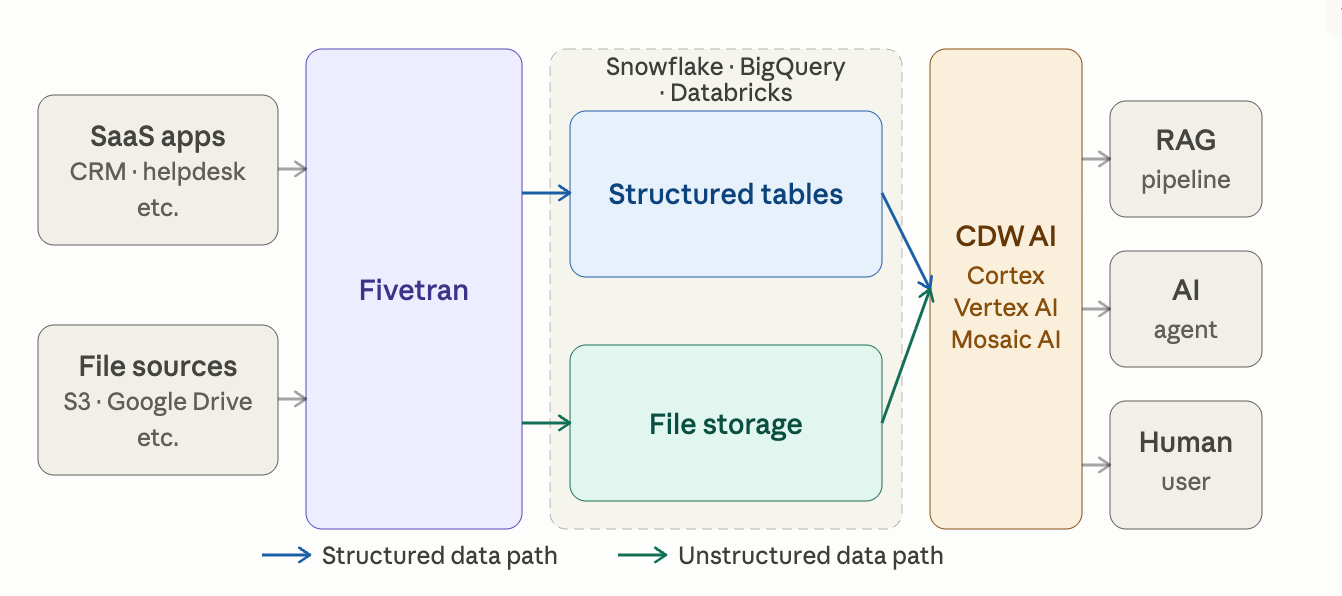
You don't just need data; you need a data foundation for AI that moves, transforms, and manages structured, semistructured, and unstructured data for your agents. Tables aren't enough; Fivetran now covers it all.
[CTA_MODULE]
Verwandte Beiträge
Kostenlos starten
Schließen auch Sie sich den Tausenden von Unternehmen an, die ihre Daten mithilfe von Fivetran zentralisieren und transformieren.